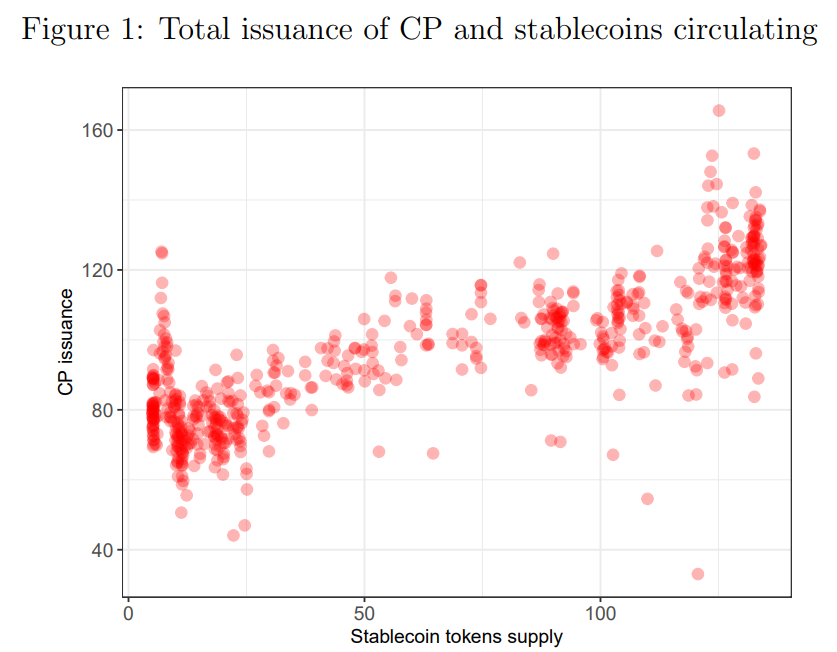
The rapid growth of stablecoins–crypto-assets aimed at maintaining a stable value–has generated a sizable demand for short-term dollar-denominated assets. Stablecoin issuers hold these assets to back their tokens and manage their peg. This paper shows that an increase in the demand for stablecoin tokens caused additional commercial paper (CP) issuance, when tokens were backed by CP. This suggests CP issuers catered to the demand emanating from stablecoins’ backing. Our results highlight a new and more general link between crypto-assets, conventional financial markets, and short-term debt issuers.
@article{barthelemy2025stablecoins,title={Stablecoins and short-term funding markets},author={Barthélemy, Jean and Gardin, Paul and Nguyen, Benoit},journal={Journal of International Money and Finance},pages={103469},year={2025},doi={https://doi.org/10.1016/j.jimonfin.2025.103469},}
Revisiting the Dynamic Impact of Asset Purchases: A Survey-Based Identification
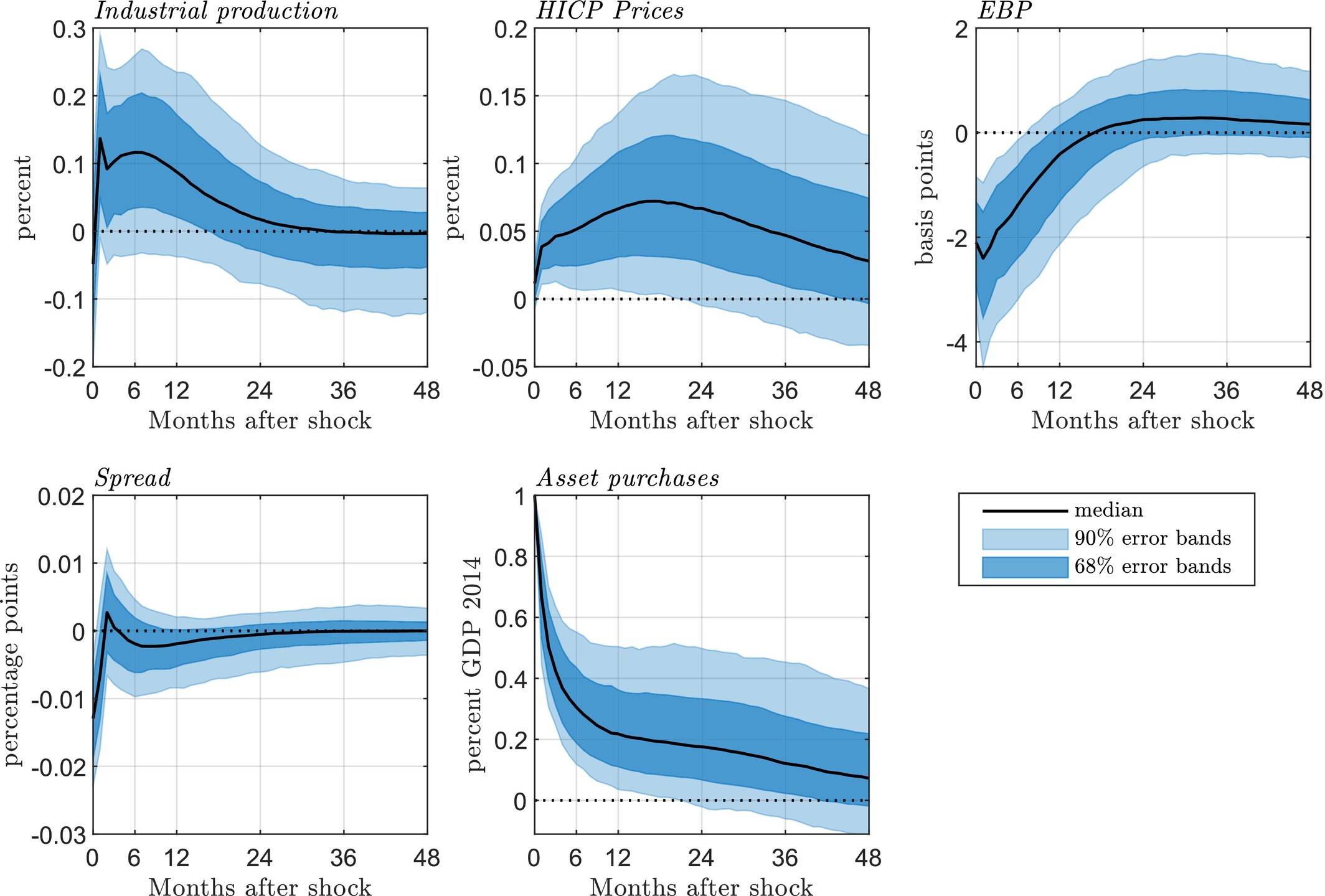
We propose a novel instrument for identifying central bank asset purchase shocks in a proxy-VAR. Our instrument exploits the deviations between asset purchase announcements and expectations inferred from quantitative surveys. Using euro area data, we find a positive impact of purchases on macroeconomic variables with high posterior probability. An asset purchase shock of 1% of GDP leads to median impacts on output and prices of 0.12% and 0.07%, respectively. The effects are three times as small as those in the US economy. Finally, we show that our instrument is stronger than high-frequency instruments, both in terms of statistical strength and alignment with narrative evidence.
@article{lhuissier2025survey,author={Lhuissier, Stéphane and Nguyen, Benoît},title={Revisiting the Dynamic Impact of Asset Purchases: A Survey-Based Identification},journal={Journal of Applied Econometrics},volume={40},number={7},pages={846-861},keywords={asset purchase programme, Eurosystem, monetary policy, proxy-VAR},doi={https://doi.org/10.1002/jae.70011},url={https://onlinelibrary.wiley.com/doi/abs/10.1002/jae.70011},eprint={https://onlinelibrary.wiley.com/doi/pdf/10.1002/jae.70011},year={2025},}
2021
Inspecting the mechanism of quantitative easing in the euro area
Ralph S.J.
Koijen, François
Koulischer, Benoît
Nguyen, and
1 more author
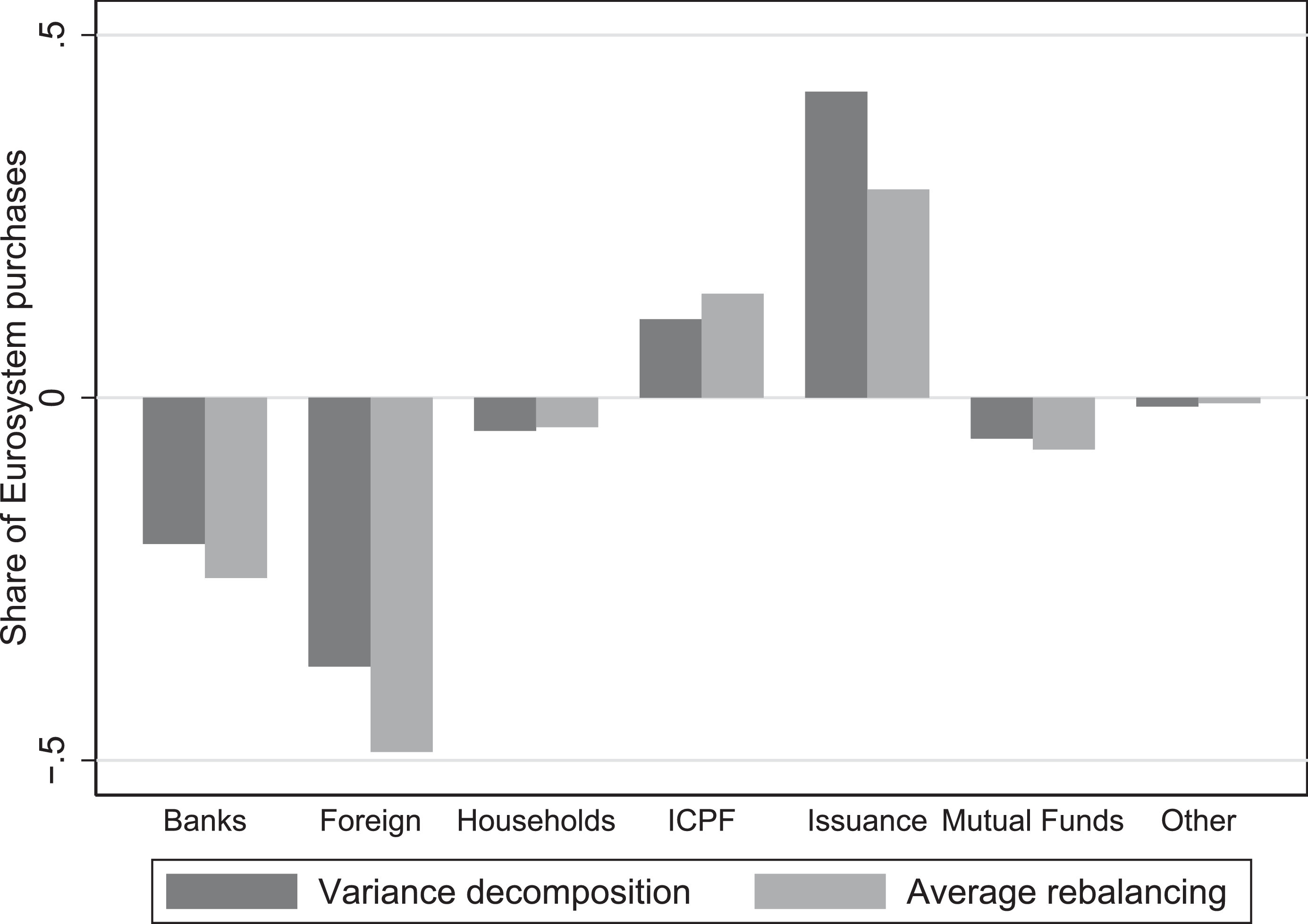
Using security-level holdings for all euro-area investors, we study portfolio rebalancing during the quantitative easing program from March 2015 to December 2017. Foreign investors outside the euro area accommodated most of the Eurosystem’s purchases. Duration, government credit, and corporate credit risk did not get concentrated in particular regions or investor sectors. We estimate a demand system for government bonds by instrumental variables to relate portfolio rebalancing to yield changes. Government bond yields decreased by 65 basis points on average, and this estimate varies from 38 to 83 basis points across countries.
@article{koijen2021euroarea,title={Inspecting the mechanism of quantitative easing in the euro area},journal={Journal of Financial Economics},volume={140},number={1},pages={1-20},year={2021},issn={0304-405X},doi={https://doi.org/10.1016/j.jfineco.2020.11.006},url={https://www.sciencedirect.com/science/article/pii/S0304405X20303123},author={Koijen, Ralph S.J. and Koulischer, François and Nguyen, Benoît and Yogo, Motohiro},keywords={Portfolio rebalancing, Quantitative easing, Risk concentration, Unconventional monetary policy},}
2020
The scarcity effect of QE on repo rates: Evidence from the euro area
William
Arrata, Benoît
Nguyen, Imène
Rahmouni-Rousseau, and
1 more author
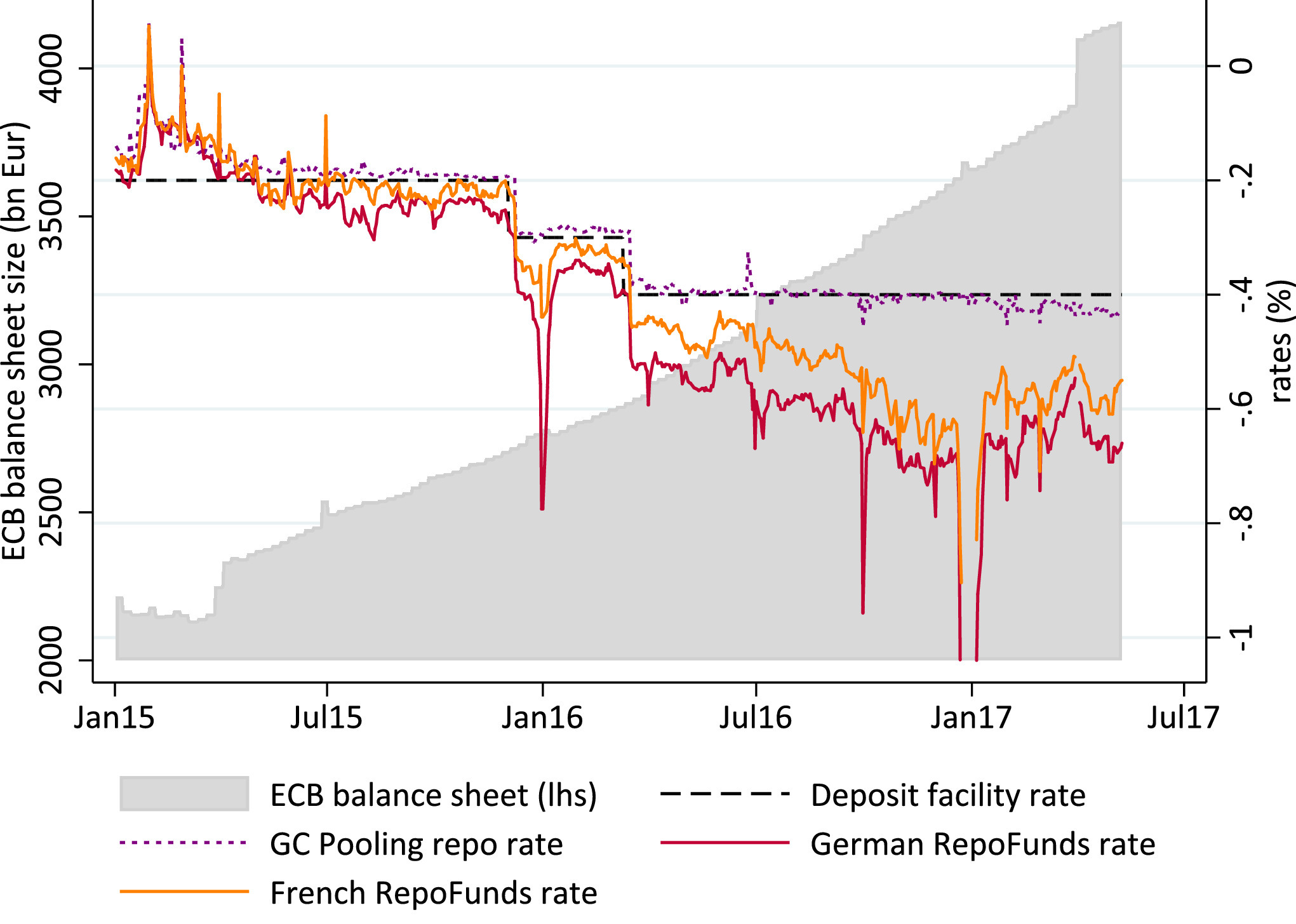
Most short-term interest rates in the euro area are below the European Central Bank deposit facility rate, the rate at which the central bank remunerates banks for excess reserves. This coincided with the start of the Public Sector Purchase Program (PSPP) launched in March 2015. In this paper, we explore empirically the interactions between the PSPP and repo rates. Using proprietary data from PSPP purchases and repo transactions for specific (“special”) securities, we assess the scarcity channel of PSPP and its impact on repo rates. We estimate that purchasing 1% of a bond outstanding is associated with a decline of its repo rate of 0.78 basis points.
@article{arrata2020scarcity,title={The scarcity effect of QE on repo rates: Evidence from the euro area},journal={Journal of Financial Economics},volume={137},number={3},pages={837-856},year={2020},issn={0304-405X},doi={https://doi.org/10.1016/j.jfineco.2020.04.009},url={https://www.sciencedirect.com/science/article/pii/S0304405X20301240},author={Arrata, William and Nguyen, Benoît and Rahmouni-Rousseau, Imène and Vari, Miklos},keywords={Specialness, Repo market, Asset purchases, Money market},}
2017
Euro-Area Quantitative Easing and Portfolio Rebalancing
Ralph S. J.
Koijen, François
Koulischer, Benoît
Nguyen, and
1 more author
American Economic Review: Papers and proceedings, May 2017
@article{10.1257/aer.p20171037,author={Koijen, Ralph S. J. and Koulischer, François and Nguyen, Benoît and Yogo, Motohiro},title={Euro-Area Quantitative Easing and Portfolio Rebalancing},journal={American Economic Review: Papers and proceedings},volume={107},number={5},year={2017},month=may,pages={621–27},doi={10.1257/aer.p20171037},url={https://www.aeaweb.org/articles?id=10.1257/aer.p20171037},}
Working Papers
Elastic in cash, inelastic in repo: Hedge funds in the treasury and repo markets
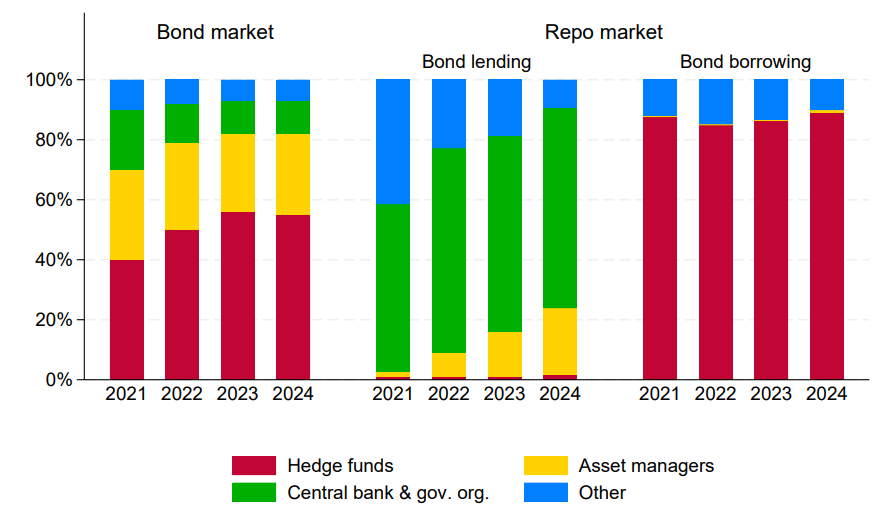
Sovereign bond markets are a cornerstone of the financial system, and their functioning is tightly linked to repo markets, where investors finance long positions and source bonds for short sales. We show, theoretically and empirically, how repo prices are fundamentally set in the cash bond market: when demand for cash bonds exceeds available supply, arbitrageurs accommodate the excess by shorting bonds and borrowing them in the repo market, opening a wedge between the policy and repo rates, i.e., generating specialness. An elastic supply of collateral, in turn, limits how much of the excess demand is capitalized into bond prices. Using regulatory data covering the universe of repos backed by German sovereign bonds, we identify the final borrowers and lenders of securities and estimate the first demand and supply elasticities for a repo market. Supply, dominated by the public sector, accounts for 87% of the aggregate elasticity. Demand, driven by hedge funds, is strongly inelastic: a 10% increase in borrowing costs reduces their borrowing by only 1%. Despite being among the most price-elastic investors in cash bond markets, hedge funds are inelastic in repo, as their borrowing sustains relative-value positions whose size is pinned by the preferred-habitat demand they intermediate: their elasticity is inherited from their cash-market counterparties rather than being a primitive. Specialness thus emerges as the equilibrium price of cash-market demand pressure—of which collateral scarcity from central bank purchases is a special case—so the same imbalances in the cash bond market affect both safe-asset pricing and the transmission of monetary policy.
@unpublished{repec:zbw:safewp:343098,type={SAFE Working Paper Series},institution={Leibniz Institute for Financial Research SAFE},author={Poinelli, Andrea and Pelizzon, Loriana and Tomio, Davide and Nguyen, Benoit and Linzert, Tobias},title={Elastic in cash, inelastic in repo: Hedge funds in the treasury and repo markets},year={2026},number={492},keywords={Monetary Policy; Repo Market; Bond Market; Safe Assets},doi={None},url={https://dx.doi.org/10.2139/ssrn.7258361},}
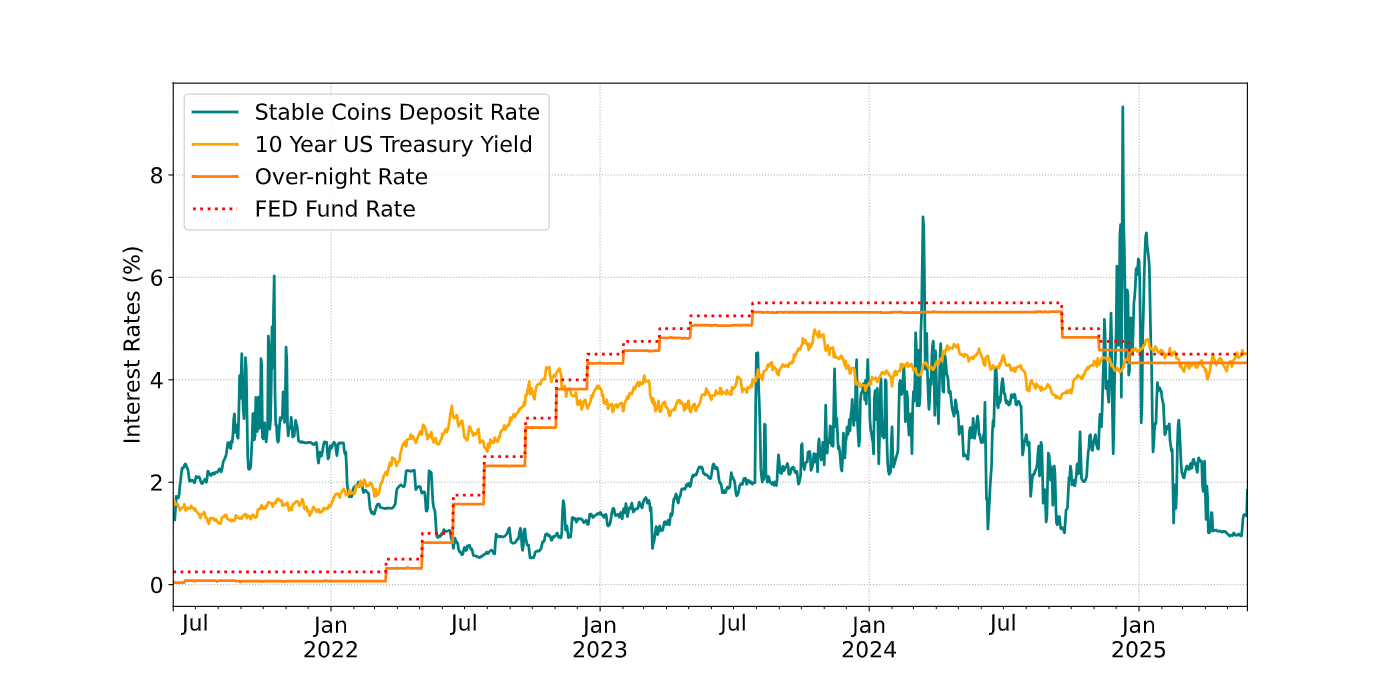
DeFi-ying the Fed? Monetary Policy Transmission to Stablecoin Deposit Rates
Does the Federal Reserve’s monetary policy influence the rates on USD-pegged stablecoins?
While major stablecoin issuers do not pay interest, investors can earn returns by depositing
stablecoins in Decentralized Finance (DeFi) protocols. We document unusually large and persistent spreads between traditional short-term interest rates and DeFi deposit rates, as well as
a weak and unstable transmission of policy rate changes. We show that, in the short run, monetary policy shocks can move stablecoin rates in the opposite direction of policy rates, delaying
a convergence that occurs only over the medium run. Both the sign of the short-run effect and the speed of convergence depend on the intensity of deleveraging induced by crypto-price reactions relative to the standard interest-rate arbitrage channel — an effect shaped by investors’
limited ability to bridge traditional and decentralized finance.
@unpublished{barbon2026defi,title={DeFi-ying the Fed? Monetary Policy Transmission to Stablecoin Deposit Rates},author={Barbon, Andrea and Nguyen, Benoit and Barthelemy, Jean},journal={ECB Working Paper No 3280},year={2026},publisher={Elsevier BV},doi={https://dx.doi.org/10.2139/ssrn.4673325},}
Stop Believing in Haircuts - At Least the Way You Think About Them
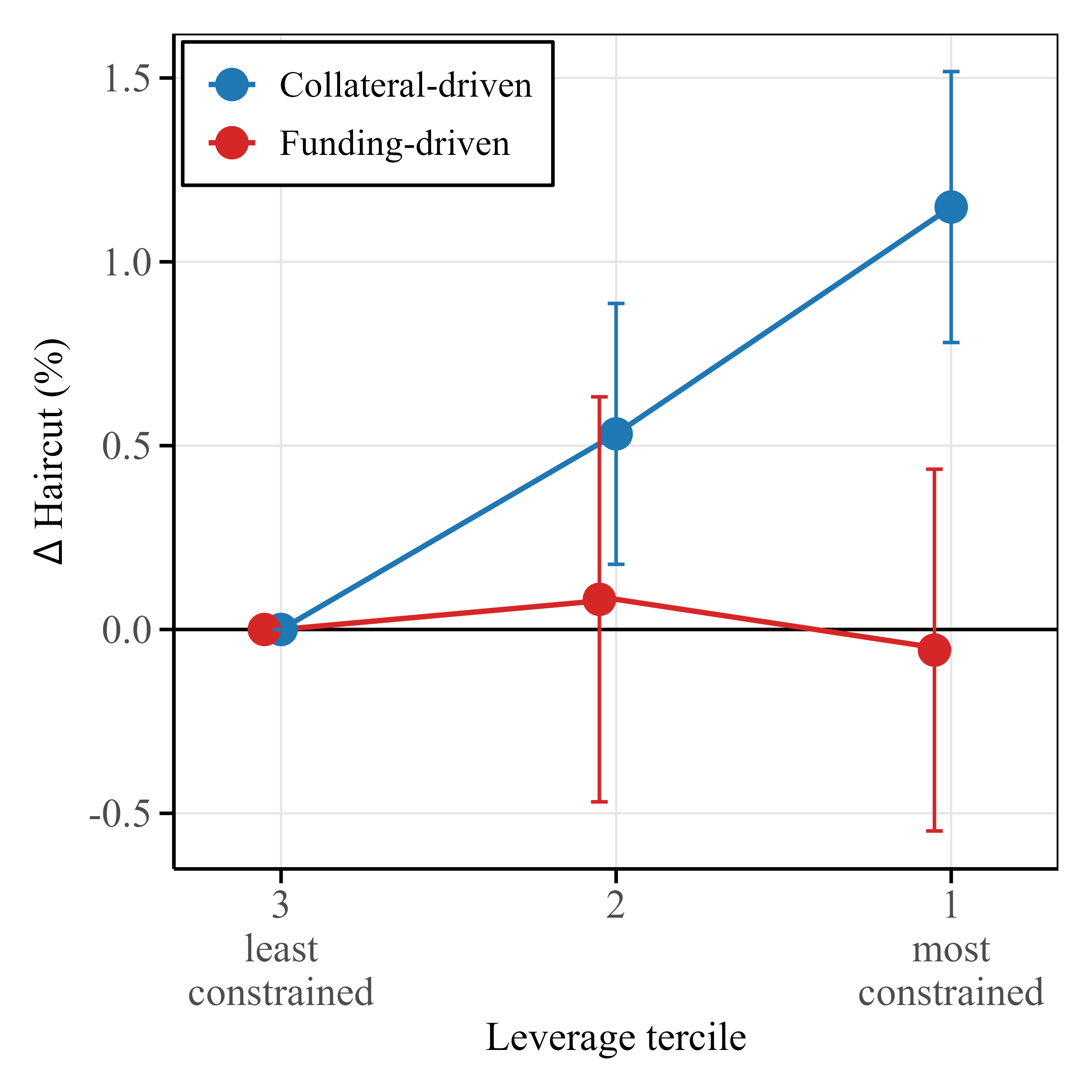
We study how frictions impact haircut setting in repo markets. Using transaction-level supervisory data and exploiting the 2021 introduction of the binding leverage ratio requirement, we show that three frictions jointly shape haircuts in the bilateral dealer-to-client segment: dealer balance sheet constraints, collateral convenience yields, and client outside options. In collateral-driven repos, binding leverage constraints and broader client outside options both raise haircuts, while higher convenience yields push them down. In funding-driven trades, the leverage constraint has no effect, higher convenience yields raise haircuts through the rehypothecation channel, and broader client outside options lower them. We rationalise these patterns in a bilateral bargaining model with periodic haircut renegotiation. Consistent with the model, constrained dealers exhibit higher repo-rate volatility and weaker pass-through of ECB policy rate changes in the collateral-driven segment. Post-crisis bank regulation thus carries potential unintended consequences for repo market functioning and the transmission of monetary policy.
@unpublished{Ballensiefen2026haircuts,author={Ballensiefen, Benedikt Fabian and Nguyen, Benoît and Knyphausen, Jasper},doi={10.2139/ssrn.5939177},issn={1556-5068},journal={ECB Working Paper},title={Stop Believing in Haircuts - At Least the Way You Think About Them},year={2026},}
Paying banks to lend? Evidence from a central bank transfer and the new euro area credit registry
Emilie Da
Silva, Vincent
Grossmann-Wirth, Benoît
Nguyen, and
1 more author
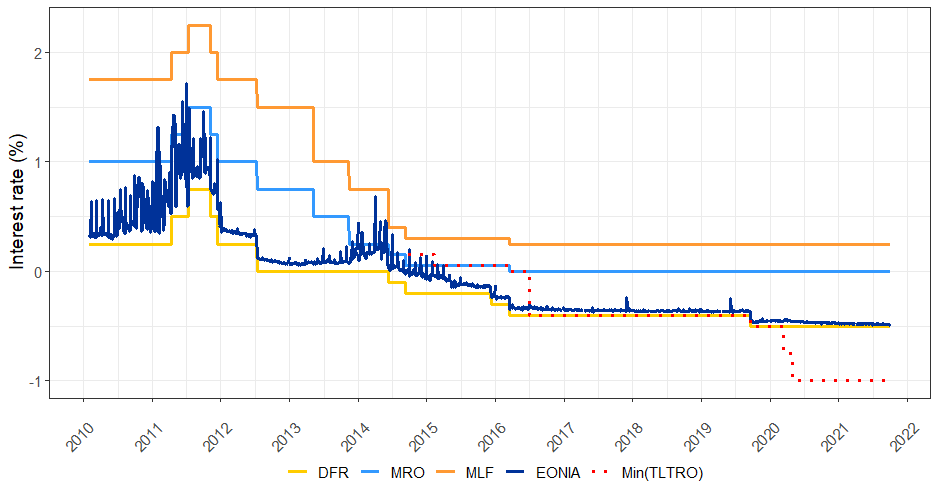
In response to the pandemic, the Eurosystem embedded a transfer mechanism in its lending operations to the banking system, during a “Special Interest Rate Period”. Using the newly available euro area credit registry, we study the effect of this direct transfer to banks. We exploit an exogenous change in the size of the program and find statistically significant effects on credit supply. We compare the impact of this program to other government interventions to support the banking system in times of crisis.
@unpublished{DaSilva2021sirp,author={Silva, Emilie Da and Grossmann-Wirth, Vincent and Nguyen, Benoît and Vari, Miklos},doi={10.2139/ssrn.3968921},issn={1556-5068},journal={Banque de France Working Paper WP 848},title={Paying banks to lend? Evidence from a central bank transfer and the new euro area credit registry},year={2021},}